Friday, October 14, 2016

Romantic Films for an iconoclastic Sweetest Day

Tomorrow is Sweetest Day, a holiday that I knew nothing about until my girlfriend who was living in Ohio informed me that people have actually been celebrating it for years in the Mid-West.  We celebrated our first Sweetest Day together over Skype.  Our relationship started long distance so we had to sync up films on our computers so that we could simulate the experience of watching a film together via Skype.  A year later we are cohabitating and she said "Yes" when I asked her to marry me.  This Sweetest Day we are spending together and we are going to watch some of our favorite romantic movies for an iconoclastic Sweetest Day.  This will be the last entry in November that I do about non-horror genre films as the rest of the month I will devote to the Halloween season.  Here is the list:


1. Harold and Maude (1971)

When we were dating long distance, over Skype, we united over this Hal Ashby film that it turned out was one of both of our favorites.  It is the story of a non-traditional romance between a death obsessed young man and an elderly woman with one foot in the grave.  The film is one of Ashby's finest (and they're almost all good) and the wonderful soundtrack from Cat Stevens doesn't hurt either.


2. Fando y Lis (1968)

After exposing my future fiance to Alejandro Jodorowsky's the Holy Mountain for the first time (without too much incident) I decided to suggest we watch another of my favorite Jodorowsky masterpieces, Fando y Lis.  With a story written by Jodorowsky's Panic Movement cohort, playwright and director Fernando Arrabal, the film is a psychedelic journey through the trials and tribulations of relationships.  Filmed in beautiful black and white with some stunning surreal mise en scene Fando y Lis still retains its status as one of my favorite films of all time.  To my surprise, she enjoyed it as well despite it's challenging pacing, disturbing themes and dense symbolism.
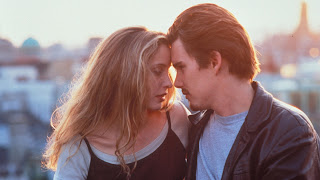


3. a. Before Sunrise (1995)
    b. Before Sunset (2004)
    c. Before Midnight (2013)

Having been a fan of Richard Linklater's meandering philosophical films like Slacker (1991) and Waking Life (2001) for some time, my future fiance suggested to me the Before films featuring Ethan Hawke and Julie Delpy and their stimulating chemistry.  The same characters appear in Waking Life so I had already been introduced to them.  Their charming philosophical ramblings provoke the viewer to look beyond the surface of reality and to explore the truth hidden beneath.  Each film is filmed almost a decade after the other and we see the characters age and their relationship seems also to age like a vintage wine.  I understand the actors were so taken by the chemistry between the characters and the philosophical issues they discussed that they helped Linkater write the second and third films.  They were nominated for an Oscar for Before Midnight.


Sunday, October 9, 2016

Young Adult Novel Adaptations: Miss Peregrine's Home for Peculiar Children

Saw this with my daughter and fiance recently at the request of my daughter.  She had read the book and enjoyed it so was interested in seeing the adaptation.  Despite some minor variations, the film stayed mostly with the plot of the book apparently.  Having not read the book, I cannot comment on these differences at this time.

What I can comment on is the apparent phenomenon of adaptations of young adult fiction novels into films.  A string of formulaic, dystopian type thrillers came on the heels of The Hunger Games (2012).

The Hunger Games actually does have a redeeming message about class, although by the end it reveals itself to be ever so slightly a reactionary message.  The Giver (2014), however, an apparent Hunger Games clone, has an entirely Ayn Randian objectivist message that I don't recall getting from the book when I read it as a teen.

I do remember it being influential on my thinking as an angsty youth who suffered as an individualist beneath the wheel of conformism.  I calk it up to youth.  Seeing the adaptation of the Giver years later revealed it to me to be a profoundly reactionary, right-wing message.  A utopian society where there are no poor, no wars and not crime but there is also not individualism sounds a lot like Cold War anti-Communism in the context of a few years of radical thinking and praxis.


This brings me to Miss Peregrine's Home for Peculiar Children (2016) directed by over-rated "auteur" Tim Burton.  First, the plot has the unfortunate odor of blockbuster super-hero type films that have flooded theaters with mediocrity lately.  The message appears to be that "peculiar" is "special" and that "special" means that you have super-powers to do things that are what Hume would define as miracles: "a violation of the laws of nature." This is maybe a liberal attempt at teaching that people with disabilities are valuable to society, but fails to convey this message as all the "peculiarities" of the children are supernatural things that are in fact very useful in a number different context.  Rather than disabilities they are super-abilities.


Tim Burton follows a string of shitty films including the bastardized remake of Willy Wonka & The Chocolate Factory (1971)Charlie and the Chocolate Factory (2005), the incredibly boring Corpse Bride (2005) and the profoundly awful Alice in Wonderland (2010).


Some of Burton's early films including Edward Scissorhands (1990), Ed Wood (1994), Beetlejuice (1988) and Mars Attacks (1996) were rather inspired.  However, at this point Tim Burton's aesthetic is tired and run down and his films are commercial, CGI-infused visual spectacles that attempt to make up for lack of good story telling by offering a lot of flashing lights on screen.

Miss Peregrine kept my attention and did have some interesting moments and ideas, but it suffered from the society of the spectacle pathology of CGI obsession and constant action rather than character development and commentary.

Rating: 6/10

Saturday, October 8, 2016

Goofy horror cinema star Justin Long

I first came across Justin Long as Warren Cheswick in the short lived, early 2000s TV show Ed.  Warren Cheswick, Ed's assistant at the bowling alley, was the epitome of the boyish man-child character that would define Long's career.

Unbeknownst to me as a youth in the 2001, Long had already starred in Jeepers Creepers and Jeepers Creepers II by the time the episodes of Ed with the Warren Cheswick character hit the airwaves.  Long's juvenile-looking face and goofy mannerisms made him perfect for the Warren Cheswick role, but how could this character actor do as the lead in a horror film?

I recently re-watched Victor Salva's Jeepers Creepers (2001) and Sam Raimi's Drag Me to Hell (2009), both starring Justin Long.


It has been a long while since I had seen Jeepers Creepers and I honestly didn't remember a lot about it.  It surprised me at how well it held my attention.  It is an entertaining adventure-type horror film with comedic and over-the-top elements.  In fact, both films in this post can be considered that type of film.  Perhaps that is why Long does so well as the lead in both.  His boyish goofiness is probably what caused Salva to cast him.

Jeepers Creepers follows brother and sister, Darry and Trish, as they attempt to go visit their parents, but are stalked by some kind of demonic monster on the way.  Rather than a horror-comedy, I would describe it more as a film that has moments where chuckles are appropriate, yet still retains its dark, creepy ambiance.  The only negative thing I would say about it is that the end does drag on a bit and the monster is shown way too much for the film to retain the uncanny suspense built around the monster in the beginning.

Rating: 7/10


The other film is drag me to hell and Long is actually a supporting actor to Alison Lohman's excellent lead performance as a savvy yet innocent professional woman who is cursed by an apparenetly Roma witch.  The film examines many elements of occult magic including Jungian psychoanalysis, Voodoo trance states, Santeria seance rituals and tarot reading.  It is also perhaps an homage to the classic horror films of the 1970s and 80s.  Thus, the over-the-top elements in the film (*possible spoiler* one scene in particular that takes place at a wake is not exactly gory, but is quite disgusting and disturbing *possible spoiler*) look to be a recycling of classic horror tropes that probably terrified audiences in the heyday of 70s and 80s gorefest, but come across as more comedic to audiences in the early 21st century.

Again, this is another of those adventure type horror films like From Dusk Till Dawn or El Dia De Bestia.  Definitely worth a watch if you're down for some light entertainment, but don't expect any kind of profound analysis of the relevance of pagan occultism in an increasingly modernized society or a lament about the struggle of the Roma diaspora.

Rating: 7/10

Monday, September 5, 2016

Don't Breathe - When Men Try Too Hard to Make Feminist Films


I recently saw Don't Breathe (2016) and immediately had some opinions on it.  The writers/directors are Fede Alvarez and Rodo Sayagues, the men behind the bastardized Evil Dead remake.  Don't Breate came off as a film directed by men that tried too hard to be a feminist film.  Instead of an emancipatory message for women who resist patriarchy, the heroine is met by disappointment, especially when men whose characters are straight from the "damsel in distress" genre of medieval legends.  She cannot count on men to save her, however, so it is up to her to discover her own method of escape, but in the end her oppressor and captor gets away because of a patriarchal, and preferential to military veterans, justice system.

I do, of course, get the irony of me, a man, criticizing a film made by men for not being feminist enough.  However, truly feminist cinema, as I have written about before, is that which is written from the female gaze and offers a genuine critique of patriarchy that offers a method for liberation.  Basically, Don't Breathe tries too hard and fails at being a feminist film.

Thursday, August 4, 2016

Deadly Blessing (1981)

The tension in this film centers around the dialectical contradiction between traditional ways of life and the idea of so-called modernity or even post-modernity.  It takes place in an area owned and worked by the Hittites, a fictitious religious Utopian community named after a Bronze Age Anatolian people.  The Hittites are based on the Amish.  According to Deadly Blessing, directed by prolific genre director Wes Craven, beneath the surface of these seemingly peaceful and harmonious communities is a profound authoritarianism and a fire-and-brimstone type demonology.  Ernest Borgnine is classic as the antagonist in the film recalling his role in The Devil's Rain (1975) opposite Tom Skerritt.


Here is the trailer:

Here is the trailer for the Devil's Rain:


This view of Utopian Christian communities is somewhat negated by the documentary The Devil's Playground (2002).  It depicts teens and young adults at a particular Amish community on their Rumspringa.  The Rumspringa is the time in an Amish youth's life where they are tasked with discovering the outside world and deciding whether or not they want to rejoin and Amish community and become baptized, official members of the Amish church.  Many of these youths behave as somewhat typical adolescants in ways, getting into drugs, technology, video games, sex, dancing etc.  Definitely worth a watch.


Watch the first part of it here:

Wednesday, August 3, 2016

Fantásticos Musicales


Fantastica (1980) is a somewhat surreal, somewhat comical, absurdist French drama with an environmentalist message.  It contains number musical numbers so if films like Tommy (1975),
The Happiness of the Katakuris (2001)

or Sgt. Pepper's Lonely Hearts Club Band (1978)


are your thing, this film might be for you.  However, my favorite absurdist musical is the Beatles' Magical Myster Tour (1967).


Check out a clip from Fantastica:


And here is a trailer for Magical Mystery Tour:


And another scene from Fantastico:

Monday, August 1, 2016

Exorcism and Demon Possession Movies Worth Watching


1. The Exorcist (1973)

Well, everybody knows the first film on this list.  It started the phenomenon of Catholic exorcism films.  Dealing with issues of faith, guilt, childhood innocence, demonology, this is probably a more Catholic film than Kevin Smith's Dogma.

Here's what director William Friedkin said to say about the Catholicism he promoted in his film to Time Out London's Tom Huddleson:

Do you believe that the film was, in part, responsible for the resurgence of Christianity in the US?
‘I know it was. I can give you specific incidents. I remember meeting James Cagney when we were both on a TV show. He said to me, “I’ve got a bone to pick with you, young man! For 35 years I had the same barber. He’s the greatest barber I’ve ever had. He saw your movie and he stopped being a barber, he entered the priesthood!”.’
So even as an agnostic, you’re okay with the idea of promoting religion?
‘Even those of us who call ourselves atheists, or think that the whole thing is rubbish, are curious about the mystery of faith. Is there anything to this stuff? “The Exorcist” offers one possible position. While I’m not Catholic, I’m overwhelmed by the idea that a 32-year-old man in a very small part of the world, who never left one word written in his own hand, has affected the lives of trillions of people. I look at the Catholic Church and I see these guys in these far-out costumes with all this gold, and I wonder what it has to do with this young man who went among the people, wore a simple robe and sandals, and healed the sick. But I also wonder how millions of people were willing to give their lives for their belief. And because I wonder, I’m curious about something like “The Exorcist”, which attributes that power to a true belief.’


This is an unsettling and creepy bit of cinema done in the found footage style.  The premise is that it's a reality show.  The film is oddly enough rated PG-13.  This is probably due to the fact that there is not really any real gore or indecency.  Actually, the creepy atmosphere results from the things left unsaid, but effectively suggested.  Altogether a sufficiently interesting and attention holding piece that warrants a second watch.


3. Angel Heart (1987)

This film is a bit of a deviation overall from the list, but there is that scene when Lisa Bonet kills that chicken really erotically when she's possessed by the voodoo spirit.  DeNiro plays the devil and Micky Rourke before his face got all fucked up from Boxing and he had to have plastic surgery plays the Private Investigator in this Neo-Noir a la Polanski's Chinatown or Scott's Bladerunner.  DeNiro peels a boiled egg really creepily.


4. The Possession (1981)

An enigmatic film about a man who suspects his wife of infidelity, but finds the reality to be much more sinister.  This film is a puzzle that reveals itself at an excruciatingly suspenseful pace.


5. The Possession (2012)

This film takes a Jewish perspective on exorcism.  A man's daughter finds a puzzlebox, which as anybody who's seen Hellraiser knows, is never a good thing.  The dad, who is estranged from the mother, seeks help of a rogue rabbi to exorcise the demon.


This is really a pretty silly film, but still it holds your attention and is actually kind of a fun romp.  It kind of reminds me of El Día de la Bestia in that way.  It is a possession story that draws on Romani lore.