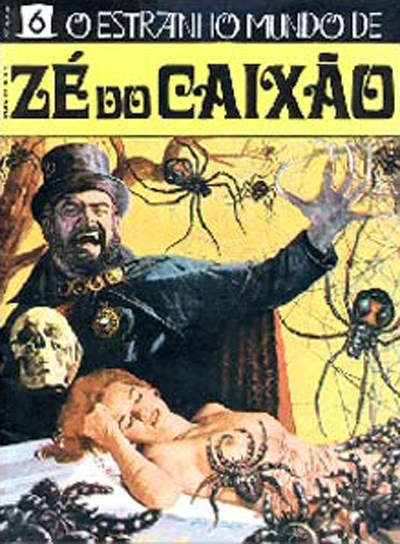
- This Night I'll Posses Your Corpose (1967)
Full film with English subtitles:
- Embodiment of Evil (2008)
Full film with Italian subtitles:
- The Hallucinations of a Deranged Mind (1978) takes you into a surreal hellscape from which Coffin Joe's victim is unable to escape. The film maker, Mojica himself, is summoned by the victim's psychiatric team to assist with his rehabilitation. However, Mojica has his own motivation for curiosity in this case. It's probably pretty arrogant to suggest that a character that one has created has the power to cause a nervous breakdown in a psychologist, but I'm fine with that.
Watch the full film here:
Everything is Terrible is filed as a director on IMDb, but it is a video project that finds the corniest, most awkward, most surreal VHS tapes, infomercials, community access television and religious programming from the 80s and 90s. They have compiled the weirdest moments from many of these videos into a few mashup style films such as Everything Is Terrible: The Movie (2009):
Sorry I haven't written in a while. I have to say, I have been not necessarily into my usual genre fare. What I've been binge watching lately is Breaking Bad. I must admit, I have formerly talked a little trash about Breaking Bad and other contemporary TV dramas.
Cinco de Mayo has become, in America, an excuse for white people to get drunk on tequila and dress up in racist stereotype costumes like sombreros and big mustaches. Of course, Cinco de Mayo is an actual holiday in Mexico, it is their independence day. Unlike American independence day, which celebrates one wealthy, elite class winning over another, Cinco de Mayo is a celebration of anti-colonialist struggle against Spanish colonialists that inspired later national liberation struggles.
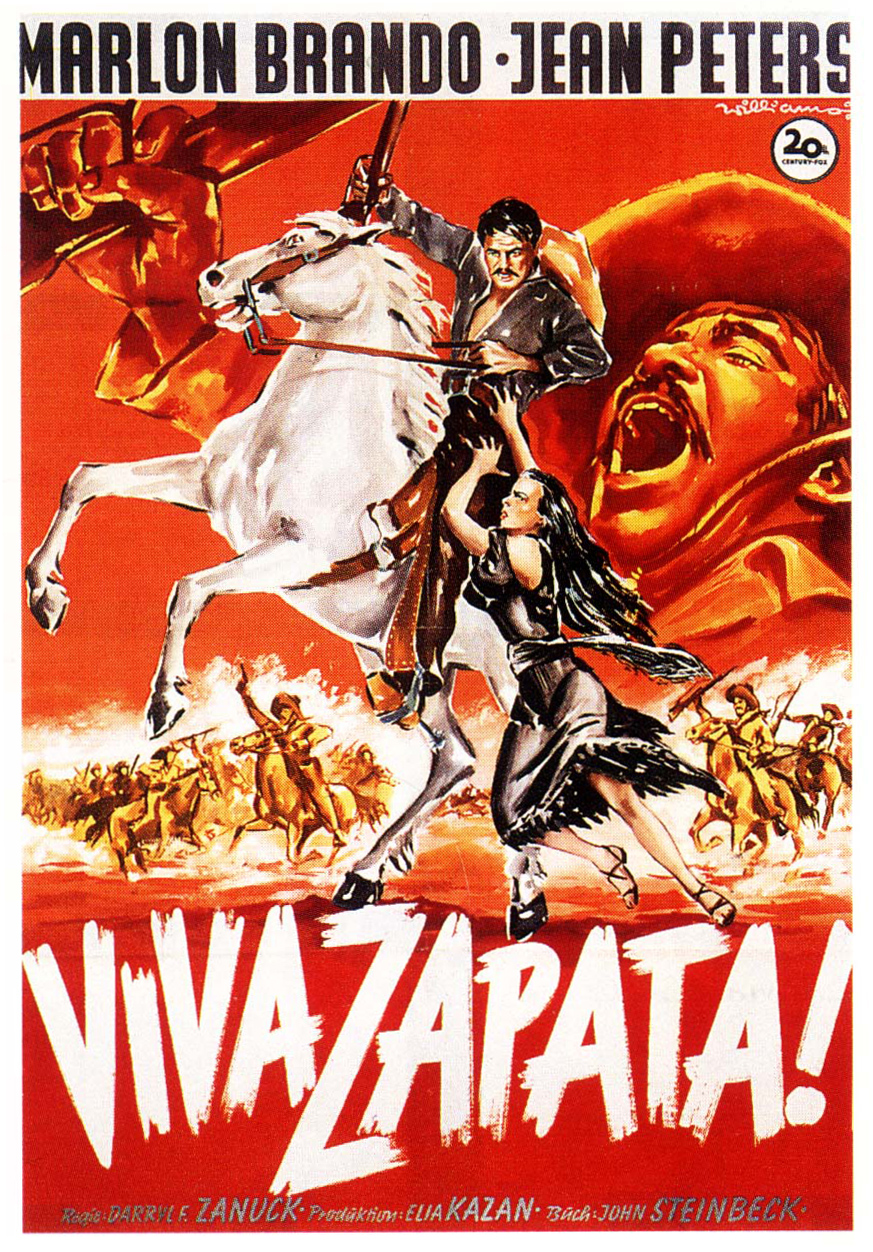
That is why it's incredibly ironic that John McCain said it was his favorite movie as he fought against and was captured by a national liberation army, much like Zapata's revolutionary army, in Vietnam. According to McCain: "Viva Zapata." It's a movie made by Elia Kazan. It was one of the trilogy of "A Streetcar Named Desire," and "On the Waterfront" and "Viva Zapata." Marlon Brando stars in it. He plays Zapata. It's a heroic tale of a person who sacrificed everything for what he believed in and there's some of the most moving scenes in that movie that I've ever seen. And one of them is he gets married. The night of his wedding night he gets up, and he and Jean Peters are in their hotel room, this little room, and she says "what's the matter?" And he says, "I gotta go to Mexico City tomorrow. I've gotta be with Poncho Villa and Modero and these people." He says "I can't read." And she reaches over and takes the bible from the table and opens it up and starts, "In the beginning." It's a great scene. It's great and there's many others that are wonderful too, especially when he dies - when he gives everything for his country and what he believes in. Source CBS News
Zapata is also the namesake of the militant-indigenous-anarchist group the Zapatistas.
My girlfriend recommended this one to me. Its director, Alain Resnais is known for Hiroshima, Mon Amour, and equally surreal and lyrical film. As soon as I began watching Last Year at Marienbad I was surprised I had never explored Resnais' filmography any further. It immediately reminded me of the experimental cinema of Maya Deren and early Luis Buñuel.
The disembodied narrator's constant voice-over is consistent with Resnais' style in Hiroshima, Mon Amour. Additionally the disjointed love story and dark themes the film plays on are also similar to Hiroshima, Mon Amour. Still, Last Year at Marienbad betrays some delightful eccentricities that make it equally as brilliant.
The motion of the camera gives the film a hallucinatory, dream-like appearance. One shot is filmed through a mirror with an ornate frame, further disorienting the viewer and separating the film from realism. The whirling organ soundtrack contributes a creepiness that makes it all the more unsettling.Perhaps not intentional, but the version that I saw had an illusion of the camera moving slightly side to side during the more stationary shots. It was probably a glitch in the transfer, but still, it added to the hallucinatory feel of the whole experience.
Arthur Penn's Bonnie and Clyde was one of the first films to break the production code era's taboo on gore and graphic violence. Of course, Bonnie and Clyde is more than just bloody bullet holes. It is actually a somewhat subversive film that follows a dust bowl Robin Hood and Maid Marian while they recruit disciples and stuff their pockets all while taking care not to exploit the impoverished.
The film takes place during the depression and FDR campaign posters are prominently displayed throughout the film. Beatty's Clyde Barrow is morally opposed to taking money from the poor, but morally inclined to take money from the banks. From the scene where he allows the sharecroppers' whose home was foreclosed by the bank to shoot up the place, Beatty's Clyde proves himself a 20th century Robin Hood. Of course, historical proof probably is inclined otherwise.
Penn's Bonnie and Clyde are not meant to be historically accurate portrayals, though. The film was released in 1967 at the heart of the so-called "Summer of Love," when the American counter-culture was possibly at its most strong. Additionally, Hollywood was suffering a lull. The supposedly depression-proof industry was suffering because they had failed to produce many memorable films during the production era (other than a handful of film Noir classics).
The ending scene of Bonnie and Clyde is considered a classic and I will spoil it for you: they get filled with bright red bullet holes. Even after reading these spoilers, the film is worth watching. It was the harbinger of a renaissance in cinema. Soon after Roger Corman, Peter Fonda and Dennis Hopper as well as Robert Downey's crew had shot some brilliant films inspired by the indulgences explored by Beatty's Bonnie and Clyde. Bless Beatty and Penn!
To avoid censorship problems, Warren Beatty held off sending a script to the Production Code Administration (PCA), the industry's self-censorship organization, until just before shooting began. Even so, PCA head Geoffrey Shurlock fought, unsuccessfully, to remove the intimation that Bonnie was nude in the first scene, the suggestion of oral sex in one bedroom scene and the scene in which a bank teller is shot in the face when he jumps on the getaway car's running board. Later Beatty had another fight to convince the head of the National Catholic Office of Motion Pictures (the successor to the Legion of Decency) that Faye Dunaway was properly covered when she runs downstairs to meet Beatty in the film's first scene. The official kept insisting that he could see her breasts.
Secrets of the Living Dolls is a BBC documentary about straight men who dress and wear plastic, prosthetic skin the makes them look like women, or at least facsimiles of women. Often they are interested in the phenomenon known as "female masking" because they are unsuccessful with women and they enjoy becoming the kinds of women they would like to meet or be with. To many they look strange and even scary, but to them they look great. There is a whole community around this sub-culture and a part of the film focuses on a meetup of female maskers in Minneapolis, MN.
Of course, if you think that's weird, imagine female masking on acid, and crystal meth... and PCP. Shaye Saint John was the character invented by artist Eric Fournier.
Here is a documentary about the Shaye Saint John story:
The back story was that Shaye was a model that was in a terrible accident and got reconstructive surgery, but got maybe a little too much. Ever the diva, Shaye continued her public life by making hallucinatory videos known as triggers. Basically, Shaye's triggers are living doll bad trips.
A playlist of Shaye's best films are included below:
Shaye's official, posthumous channel can be subscribed to here.
Why is this all so freaky though? It's noting you can necessarily put your finger on that ostensibly scares the viewer. There is no violence or rape or torture. It's actually pretty harmless on the surface.
It has something to do with the Uncanny Valley. The uncanny valley is a hypothesis developed by robotics scientist Masahiro Mori in 1970. According to Wikipedia:
Mori's original hypothesis states that as the appearance of a robot is made more human, some observers' emotional response to the robot will become increasingly positive and empathic, until a point is reached beyond which the response quickly becomes that of strong revulsion. However, as the robot's appearance continues to become less distinguishable from that of a human being, the emotional response becomes positive once again and approaches human-to-human empathy levels.[9]
This area of repulsive response aroused by a robot with appearance and motion between a "barely human" and "fully human" entity is called the uncanny valley. The name captures the idea that an almost human-looking robot will seem overly "strange" to some human beings, will produce a feeling of uncanniness, and will thus fail to evoke the empathic response required for productive human-robot interaction.[9]
That is also probably why I Feel Fantastic fascinates so many viewers.